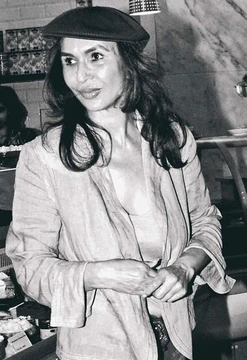
Elsa Maxwell
American hostess and columnist who popularized scavenger hunts.

She popularized the scavenger hunt and treasure hunt as party games in the modern era.
- known_for
- Popularizing scavenger hunt and treasure hunt as party games; hosting parties for royalty and high society; syndicated gossip column; radio program Elsa Maxwell's Party Line
Lore & Background
Despite a persistent rumor that Elsa Maxwell was born in a theater in Keokuk, Iowa, during a performance of the opera Mignon, she admitted late in life that the story was a fabrication; she was actually born at her maternal grandmother's home in the same town. Maxwell never completed grammar school because her father did not believe in formal education and tutored her at home. Her interest in parties began at age 12 when she was told she would not be invited to a party because her family was poor. Later, the principality of Monaco employed her services to put it on the map as a tourist destination. Maxwell and Porter were lifelong friends, and he mentioned her in several of his songs. Returning to the U.S., she worked on movie shorts during the Depression, unsuccessfully. Following World War II, she gained an audience of millions as a newspaper gossip columnist.
Reader's Guide
Elsa Maxwell's significance lies in her role as a self-made arbiter of high society and a pioneer of modern party entertainment. By introducing scavenger hunts and treasure hunts as party games, she transformed social gatherings into interactive spectacles. Her influence extended through her syndicated gossip column and radio program, which gave her a platform to shape public perceptions of royalty, celebrities, and social elites. Despite criticism from figures like Simone de Beauvoir, Maxwell's career demonstrates how social networking and media savvy could create cultural power outside traditional structures.
Did You Know?
- Maxwell popularized the scavenger hunt and treasure hunt as party games in the modern era.
- She admitted late in life that the story of her being born in a theater during an opera was a fabrication.
- Maxwell was a closeted lesbian who had an almost 50-year partnership with Scottish singer Dorothy Fellowes-Gordon.
A Childhood Among Grand Mansions
Her childhood was shaped by two extraordinary estates in Rhinebeck, New York. On her father's side stood Hopeland House, a sprawling thirty-five-room Tudor Revival mansion that her own father had designed. On her mother's side was Staatsburg on Hudson, another grand property overlooking the river. Between these two houses, young Helen absorbed a world of architectural grandeur and old-money comfort. For her schooling, she attended institutions in Dobbs Ferry, a short distance from her family's Hudson Valley holdings. This early immersion in a landscape of stately homes and cultivated grounds would echo throughout her adult life, from the political salons she later hosted to the arts institutions she championed. The Dinsmore and Huntington families carried deep roots in both politics and culture, a heritage Helen would carry forward with equal passion and generosity.
A Lifelong Devotion to Music and the Stage
Helen's relationship with music began almost before she could walk; she attended her very first opera at the age of two. That early spark grew into a deeply involved patronage of the performing arts across New York. She helped found both the New York City Center and the New York City Opera, and she maintained a standing patronage of the Metropolitan Opera, where she held two private boxes—one for herself and one reserved for guests. She also attended the opening night at Philharmonic Hall, an event directed by her close friend Leonard Bernstein. Her institutional commitments extended to the boards of the New York City Ballet, the New York Philharmonic, and Lincoln Center for the Performing Arts, and she served as a trustee of the Metropolitan Museum of Art. Beyond governance, she created the Musicians' Emergency Fund to generate teaching and performing positions for struggling artists.
The Political Hostess of the Hudson Valley
Helen's political life was inseparable from her social one. Over the decades she was a guest at the inaugural balls of four presidents: Calvin Coolidge, Herbert Hoover, Dwight D. Eisenhower, and Richard Nixon. She counted Nelson and Happy Rockefeller among her close friends. She tore down the old mansion and commissioned architect John Churchill to build Locusts on Hudson in the Neobaroque style. There she hosted lavish gala fundraisers and kept six dogs, while at Hopeland House she held the more formal Republican political events that drew former presidents to her table.
Love, Friendship, and a Final Bow
The couple had known each other since childhood, their families' estates—Hopeland House and Ferncliff—lying just a few miles apart. The press dubbed her a charming American girl. She chose Ferncliff as their primary residence because she had little appetite for New York society life. They honeymooned aboard his yacht, the Noma, later loaned to the U.S. Army during the First World War. The marriage, however, was largely one of parallel lives; Helen preferred the company of her female friends, and the writer Glenway Wescott once labeled her a grand old lesbian. Her circle included Elsa Maxwell, Cole Porter, and Maury Henry Biddle Paul, known as Cholly Knickerbocker. That same evening, Carlos Moseley, president of the New York Philharmonic, opened a concert at Avery Fisher Hall by calling her one of the great music lovers and benefactors of her time.
More in Philanthropists And Socialites 1-23
Spotted an error? Know more?
This is a living reference — every entry is fact-audited, and reader corrections feed straight into our audit queue. Suggest an edit · See this site's audit record